Science Breakfast
As part of the BioTechMed-Graz Science Breakfasts, guest lectures are given on current scientific and socially relevant topics. The event always takes place on the first Wednesday of the month at the University of Graz.
Next date:
NEW DATE!
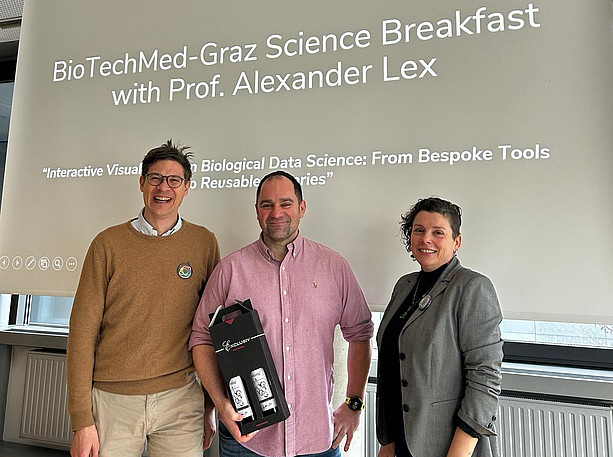
Speaker: Alexander Lex (Graz University of Technology)
Title: “Interactive Visualization in Biological Data Science: From Bespoke Tools to Reusable Libraries”
Date: Wednesday, 11.02.2026, 8.30 a.m.
Location: University of Graz, RESOWI Centre (SZ 15.21 -2nd floor, part A)
Abstract:
Interactive data visualization is central to modern data science, particularly within the life sciences. It enables researchers to directly engage with their data, quickly explore hypotheses, and uncover patterns with minimal friction. Visualization solutions range from highly specialized tools designed for specific biological challenges to flexible, general-purpose libraries used across domains.
In this talk, I will present two examples at opposite ends of this spectrum. The first is a bespoke, domain-specific visualization system developed to address the complex task of analyzing live-cell microscopy data. The second demonstrates how interactive visualizations can be seamlessly integrated with Python code in Jupyter Notebooks, creating a powerful environment for exploratory analysis. Together, these examples highlight both the current landscape and future potential of visualization in biological data science.
About the Speaker:
Alexander Lex is a Professor of Human–Computer Interaction in the Institute of Human-Centred Computing at Graz University of Technology. He directs the Visualization Design Lab, where his group develops visualization methods and systems for advancing scientific research.
He is the recipient of an NSF CAREER award and multiple best paper awards at venues such as IEEE VIS and ACM CHI, as well as a best dissertation award from his alma mater. He co-founded Datavisyn (http://datavisyn.io), a company focused on visualization solutions for the pharmaceutical industry.
His lab has produced widely used visualization tools, including UpSet, a popular set visualization technique, as well as platforms such as reVISit, MultiNet, and trrack.
Before joining Graz University of Technology, he was a Professor at the University of Utah and previously a lecturer and postdoctoral researcher at Harvard University. He holds bachelor’s, master’s, and PhD degrees from Graz University of Technology and was a visiting researcher at Harvard Medical School in 2011.
http://alexander-lex.net